Optimizing for AI search engines: ChatGPT, Google AI, Perplexity.
Home > Complete GEO Guide 2026
This GEO guide explains Generative Engine Optimization, the practice of structuring content so it can be selected, synthesized, and cited by AI-powered search engines like ChatGPT, Google AI Overviews, Perplexity, and Copilot. Unlike SEO, GEO prioritizes answerability, information density, credibility, and machine-readable structure over rankings and clicks.
This guide covers GEO from end to end: why search has changed, what AI engines look for in content, how it is measured and where to start in 2026. Last updated: September 25, 2026. It accompanies our AI search engine optimization offer. How we apply it at Sekoia is set out in our GEO method, the terms used in our GEO glossary, and market figures, checked at their source, in our GEO statistics 2026.
Search is no longer primarily a list of links. It is becoming a layer of answers. Users ask longer questions, expect decisions and summaries, and increasingly accept a synthesized response as "good enough." That changes the job of your website: it is not only to attract clicks; it is to become a trusted source that AI systems choose to cite.
This shift is not theoretical. The interface changed first (AI Overviews, conversational search, "ask follow-ups"), then user habits adapted. The effect is simple: visibility is moving upstream, inside the answer itself. If you are not selected as a source, you can lose the discovery moment even if your SEO is decent.
The second change is the rise of multi-engine discovery. People don't just "Google it" anymore. They ask ChatGPT, Perplexity, Copilot, Claude, Gemini, then cross-check. That means your brand's discoverability is now distributed. Traditional SEO is necessary, but it is not sufficient.
Finally, the competitive dynamic is different. In classic SEO, you could fight for page 1. In AI answers, the system may cite only a handful of sources. That creates a winner-takes-more environment. Early adopters who build citable, structured knowledge assets can lock in a disproportionate share of visibility.
Generative Engine Optimization is the discipline of increasing how often your content is used as a source inside AI-generated answers. In practical terms, GEO increases the probability that an AI engine will:
GEO is not "writing for robots." It is writing in a format that is easy to extract, difficult to misinterpret, and clearly trustworthy. The best GEO content reads like a high-quality guide written for humans, but engineered for machine readability.
A useful way to think about GEO:
If your content is overly promotional, vague, or lacks data, it can still rank in SEO, but it will often be ignored by generative engines. AI systems cite content that explains, defines, compares, and quantifies.
Different platforms vary, but most AI search experiences follow a similar logic:
What this implies: you do not rank the same way you do in SEO. You must be retrieved, understood, and trusted. The best GEO pages are designed to make those steps easy.
SEO is still foundational: if your site can't be crawled, loads slowly, or lacks topical relevance, you won't even enter the retrieval set. But GEO adds further requirements, because AI engines behave like extraction-and-synthesis systems.
Key differences that change execution:
The bottom line: SEO brings you into the conversation; GEO gets you quoted in the conversation.
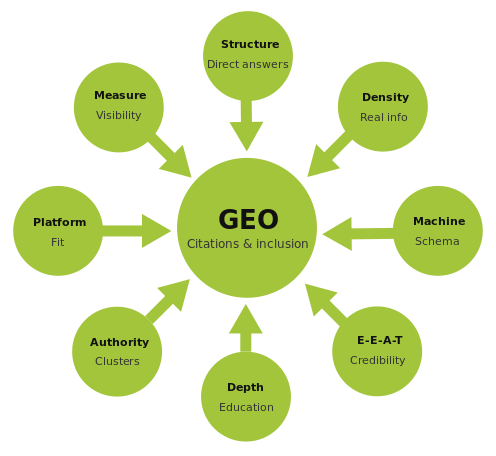
AI engines prefer content that is easy to extract and hard to misread. You win at GEO when your page behaves like a clean reference source.
Direct answers first. Start sections with a short definition or conclusion in plain language. In many cases, the engine only needs one or two strong paragraphs to cite you.
Information density. The page must carry real informational value, not filler. A good rule: each section should contain specific claims, distinctions, steps, constraints, or quantified facts.
Specificity and citability. Write sentences that can stand alone and still be true. Avoid ambiguous claims ("best," "leading," "innovative") unless you can define them.
Credibility signals. AI systems favor content with:
Structured formatting. Use meaningful H2 and H3 headings, short paragraphs, and occasional tables where comparisons matter. Structure is not decoration; it is machine guidance.
These pillars are the operating system of a GEO program. If you do only one or two, you will see limited impact. If you build all eight, you can become a default source.
Our GEO score assesses a site against eight weighted criteria, several of which overlap with these pillars: structured data, information density, topical authority and educational content.
The formats that perform best share one trait: they behave like reference material.
If you want an AI engine to cite you, you need content that looks like a source, not an advertisement.
Technical GEO is not an "extra." It is the layer that helps machines interpret you accurately. Key foundations:
Your content can be great, but without machine-readable structure it is harder to extract, and you lose to sources that are easier to parse.
You don't optimize one way for everything. You aim for fundamentals that work across platforms, then adapt.
ChatGPT-style engines. They favor comprehensive guides, clear definitions, strong structure, and an "explain it like I'm smart but busy" style. Make authorship and credibility obvious.
Google AI Overviews and Gemini. SEO fundamentals still matter heavily. Structured data and FAQ structures are often decisive. Clarity and factuality beat clever copy.
Perplexity. Perplexity tends to cite more heavily. Freshness, scannability, and explicit sources matter. Comparative and data-led pages perform well.
Copilot and Bing. They often behave like a retrieval experience blended with answer synthesis. Authority signals and clear topical coverage help.
You measure GEO differently from SEO. Rankings are not the main indicator. Track:
The goal is not only traffic. The goal is to become the default reference. At Sekoia, this measurement follows a constant testing protocol.
Example: a B2B SaaS integration platform. If the market searches "how to sync HubSpot with X," AI engines prefer pages that clearly define what syncing means, which fields are involved, the typical failure modes, and the exact steps. A strong GEO play is to publish a pillar guide plus a glossary of key objects and common mapping patterns, then add structured data and author credibility.
Example: insurance and finance. AI answers tend to cite neutral explainers, comparisons, and "what is covered, what is not" content. Case studies help when they include constraints and numbers. The strongest assets are often state-of-the-market reports and FAQs with structured markup.
A realistic roadmap has three phases.
Phase 1, foundations (0 to 3 months). Build the content base: pillar pages, FAQs, glossaries. Fix structure and structured data. Establish authorship and update policies. Launch measurement.
Phase 2, authority and differentiation (3 to 6 months). Add original data, case studies, neutral comparisons and lessons-learned reporting. Refresh key pages and strengthen internal linking.
Phase 3, scale and defensibility (6 to 12 months). Expand coverage, publish regularly, build external authority (mentions, partnerships), and iterate based on visibility tracking. Optimize per platform using observed citation patterns.
The most important long-term shift is that AI becomes the interface and websites become the source layer. This changes how value is created. In the past, visibility came from ranking. In the future, visibility comes from being the trusted source that answers are built on.
That will reward organizations that treat content as a knowledge asset: structured, updated, evidence-backed, authored, and internally connected. It will penalize organizations that treat content as purely promotional material.
The brands that win in 2026 won't be the ones with the most content. They will be the ones with the most citable content.
Generative Engine Optimization is the discipline of increasing how often your content is used as a source inside AI-generated answers. It increases the probability that an AI engine retrieves your page, extracts your facts cleanly, trusts it enough to include it, then cites or references it explicitly.
SEO optimizes for ranking: position, clicks, sessions. GEO optimizes for selection: being chosen as a source. SEO is still foundational, because a site that can't be crawled never enters the retrieval set, but GEO also requires clear structure, evidence and direct answers.
The ones that behave like reference material: pillar guides, glossaries, FAQ libraries, neutral comparisons, case studies with their constraints and results, and data reports with their methodology. Content that looks like an advertisement is rarely cited.
Not by rankings. You track the AI visibility score, meaning the percentage of target queries where you appear, share of AI voice compared with competitors, citation frequency over time, position within answers, and AI-referred sessions and leads when attribution makes them trackable.
With the foundations, in the first three months: pillar pages, FAQs and glossaries, structure and structured data fixed, authorship and update policies, then measurement launched. Authority and differentiation come next, from 3 to 6 months, then scale, from 6 to 12 months.
Yes. AEO (Answer Engine Optimization) and GEO (Generative Engine Optimization) describe the same practice: being cited, and accurately described, in AI engine answers. The first name comes from featured snippets and voice search, the second from academic research. HubSpot chose AEO, which is why we use both. We explain it in AEO or GEO: two names for the same discipline.
Sekoia is a lean growth agency that helps small and medium-sized businesses perform better in highly competitive markets. Pioneers in Generative Engine Optimization (GEO) in Quebec.
COPYRIGHT @ SEKOIA – 2026