An accessible site is a site anyone can use. Including your customers.
Home > Web accessibility
Web accessibility means designing a site that any person can understand, use and navigate, whatever their visual, hearing, motor or cognitive abilities. At Sekoia, we assess your site, we fix what blocks people, and we bring you into line with the standards that actually apply to you, without taking your site down along the way.
Accessibility means that all people can understand, use and interact with electronic information, and become active, contributing members of the digital world. In practice: text you can read when your sight is poor, a form you can complete with a keyboard when a mouse is not an option, a video you can follow without sound, a page a screen reader announces in the right order. Nothing exotic. These are things that can be checked, and fixed.
In Quebec, standard SGQRI 008 version 3.0 has been in force since 29 April 2024. It targets WCAG 2.1 level AA, supplemented by WCAG 2.2 criteria, and it applies to public bodies and government enterprises: new content must comply from the design stage, existing content as soon as it undergoes a significant change. In Ontario, the AODA sets its own deadlines. In the United States, the ADA and Section 508. In Europe, EN 301 549. We work from the framework that genuinely applies to you, not from a generic checklist.
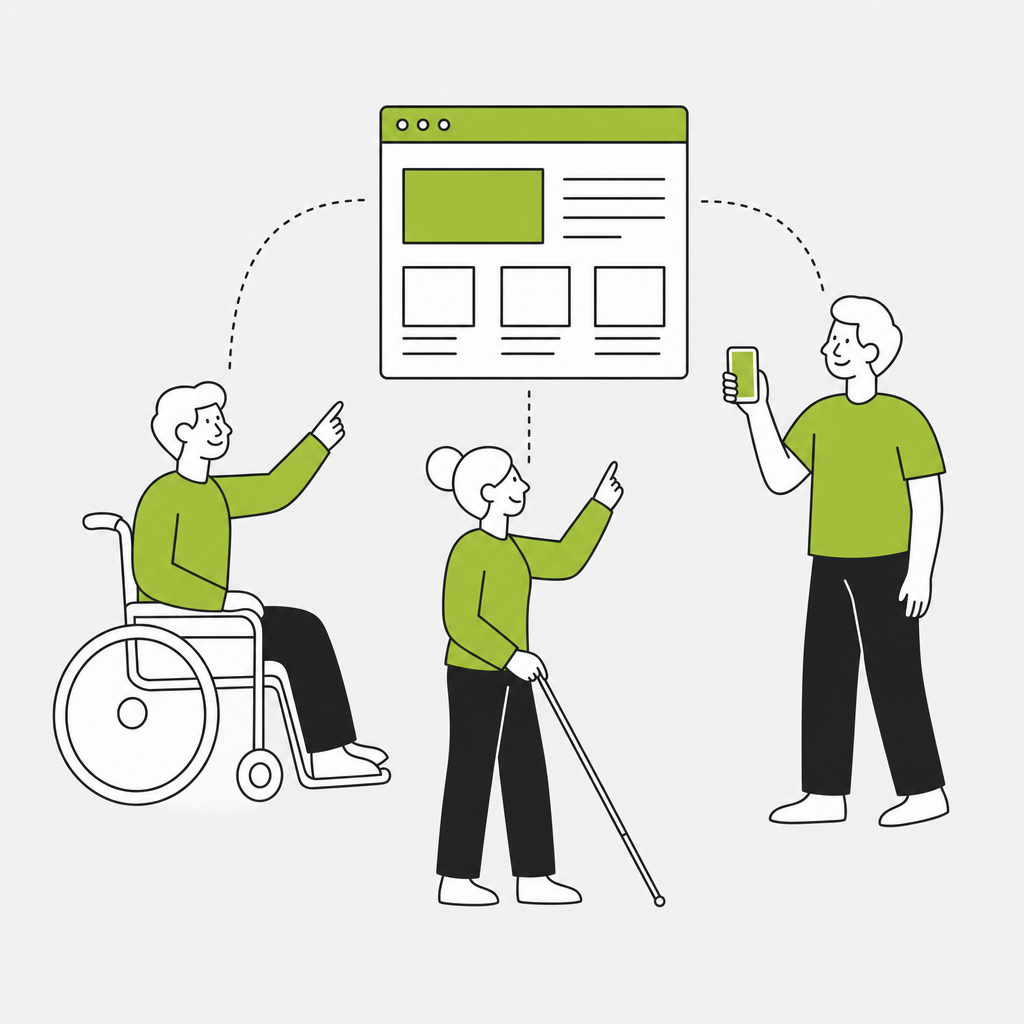
We start with a full assessment of your site, which we provide free of charge. You get the list of barriers, ranked by severity and by effort, with what each one prevents and who it prevents. Then we fix them, making sure there is no downtime on your site while the work happens. Our work is entirely transparent: you see what is fixed, when, and why.
Accessible design benefits everyone, not only people with disabilities. Sufficient contrast also serves the person reading their phone in bright sun. Captions also serve the person watching a video on a train. A clean page structure also serves search engines, and now generative ones, which read your pages with much the same tools as a screen reader: headings, labels, text alternatives. An accessible site is a site machines understand better, and it is rarely a coincidence that the two go together.

Share of home pages with at least one automatically detectable WCAG 2 failure, across one million pages analysed. (WebAIM Million, February 2026 sample)
Average number of detected failures per home page, across that same million pages. (WebAIM Million, February 2026)
People living with significant disability worldwide, or 16% of the population, one in six. (World Health Organization, fact sheet of 7 March 2023)
It depends on who you are and where you operate. In Quebec, standard SGQRI 008 3.0, in force since 29 April 2024, targets public bodies and government enterprises. In Ontario, the AODA covers a wider scope. In the United States, the ADA applies to private business and Section 508 to the federal sector. A private Quebec company with no public-sector clients often has no direct obligation, which does not mean it has no interest in the matter. We always start by establishing what applies to you.
WCAG level AA is the reference adopted by nearly every text, including the Quebec standard, which adds WCAG 2.2 criteria and exempts two points, live captions and pre-recorded audio description. Level AAA exists, but it is nowhere required across the board and it is hard to sustain on a full site.
Statistically, quite badly. The February 2026 WebAIM sample found at least one automatically detectable WCAG failure on 95.9% of the home pages analysed, averaging 56.1 failures per page. The causes are almost always the same: insufficient text contrast in 83.9% of cases, images without text alternatives in 53.1%, form fields without labels in 51%. These are common failures, and fixable ones.
Indirectly, yes, and the reason is simple. A search engine reads your page much as a screen reader does: heading hierarchy, labels, text alternatives, structure. What makes a page understandable to a blind person makes it understandable to a machine. It is not a shortcut to ranking, but the two efforts reinforce each other.
No, and that is a condition of how we work. We work without downtime, and fixes are presented before they are applied. An accessible site is not a rebuilt site: in the great majority of cases it means correcting contrasts, labels, alternatives and navigation order, not reconstructing everything.
Yes. We assess your site and hand you the findings with no commitment. It is our way of starting a conversation on facts rather than on a promise.
In four stages: a free audit of your site against the framework that concerns you, prioritizing the barriers by severity and by effort, fixing them without downtime, then keeping it up over time. The detail is in our accessibility audit method.
Sekoia is a lean growth agency that helps small and medium-sized businesses perform better in highly competitive markets. Pioneers in Generative Engine Optimization (GEO) in Quebec.
COPYRIGHT @ SEKOIA – 2026