The same traffic, more customers.
Home > CRO: conversion rate optimization
Conversion rate optimization, or CRO, turns a larger share of the visitors you already have into customers, without buying more traffic. At Sekoia, that means analysing your funnels, running A/B tests on the pages that matter, and using tools such as Unbounce or HubSpot depending on your ecosystem.
Attention usually goes to everything that happens before the visit: search, campaigns, content. Then visitors arrive, and a large share leaves without doing anything. CRO works on that part. Moving a conversion rate from 1% to 2% doubles the number of customers without adding a dollar of media. It is the only lever that improves every other one at the same time.
CRO is not a collection of tricks. We start by looking at where people come in, where they stop and how many leave at each step. Once the funnel is mapped, the priorities become obvious: it is almost never the home page, it is often a form that is too long, a checkout step that worries people, or a landing page that promises something other than the ad leading to it.
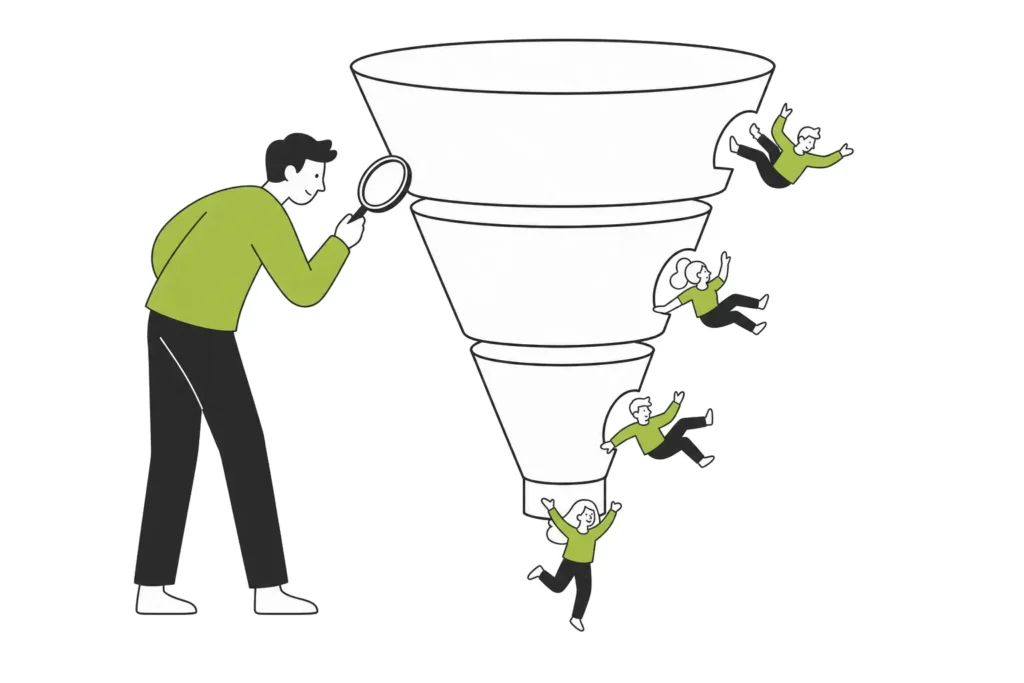
We are data analytics experts and numbers obsess us. An improvement idea stays a hypothesis until it has been tested: we put it through an A/B test with a protocol that holds, meaning one change at a time, enough traffic and enough time for the result to mean something. What wins goes live, what loses is documented, and nobody has to defend personal taste.

We work with Unbounce for landing pages, with HubSpot for forms, journeys and tracking through to the sale, and with other tools when your ecosystem calls for it. The tool follows the journey, never the other way round. And since CRO is sold on its own, you can hand it to us without changing anything else in your marketing.
See the case of an insurance brokerage firm: persona-based campaigns, retargeting and a dashboard, in four phases.

Average online shopping cart abandonment rate, calculated across 50 studies run between 2006 and 2025. (Baymard Institute, updated 22 September 2025)
Top reason for abandonment cited by shoppers: extra costs too high, shipping and taxes included. (Baymard Institute)
Share of marketing teams who use A/B testing, the most widely used measurement method. (Supermetrics, 435 respondents, 2026 report)
CRO stands for conversion rate optimization: the share of your visitors who do what you want them to do, buy, fill in a form, request a quote. Optimizing that rate means getting more customers from the traffic you already have, rather than buying more visitors to make up for a journey that leaks.
The Baymard Institute puts it at 70.22%, an average calculated across 50 studies run between 2006 and 2025. In other words, seven carts out of ten never close. The top reason shoppers give is not the product price but the extra costs, shipping and taxes included, at 40%.
Enough for the result to mean something. Below a certain volume, a test decides nothing and gives the illusion of an informed decision. When traffic is thin, we start with the obvious fixes found in the funnel analysis, and we keep testing for the pages that get enough of it.
Unbounce for landing pages, HubSpot for forms, journeys and tracking through to the sale, and other tools when your ecosystem calls for it. We do not change your technology stack for the fun of it: the tool follows the journey, never the other way round.
No, it makes them profitable. Search and advertising bring visitors, CRO decides what becomes of them. Improving the conversion rate raises the return of every channel at once, including the media budget you already spend.
Almost never. Most gains come from precise changes on a few pages: a shortened form, a clearer checkout step, a landing page aligned with the ad that leads to it. Rebuilding the whole site means starting from zero without knowing what was working.
In four stages: funnel analysis, to see where your visitors are lost, hypotheses prioritized by estimated impact, effort and available traffic, A/B tests with one change at a time, then rolling out what wins. It is how our three-phase method applies to conversion.
Sekoia is a lean growth agency that helps small and medium-sized businesses perform better in highly competitive markets. Pioneers in Generative Engine Optimization (GEO) in Quebec.
COPYRIGHT @ SEKOIA – 2026